Silicon Under Pressure: How Trail Camera Manufacturers Are Managing Chip Price Volatility
Why Chip Costs Hit Trail Cameras Harder Than Most Categories
A modern trail camera is, at its core, a surprisingly silicon-intensive product for its price point. A mid-range cellular trail camera contains at least five discrete chip categories:
• Image sensor (CMOS, 1–36 megapixels)
• SoC / ISP (image signal processor handling encoding, noise reduction, AI inference)
• Cellular modem (4G LTE-M or Cat-1 bis for network connectivity)
• PIR signal processor (passive infrared motion detection and threshold logic)
• Power management IC (handling solar input, battery charging, and load distribution)
Each of these is sourced from a different supplier ecosystem, priced in USD, and subject to different supply and demand cycles. When any one of them experiences a price spike — as image sensors did in 2021–2022 following pandemic-era fab capacity constraints — the bill of materials for a single camera can shift by $8–15 in weeks. On a product retailing between $60 and $180, that is a margin-altering event.
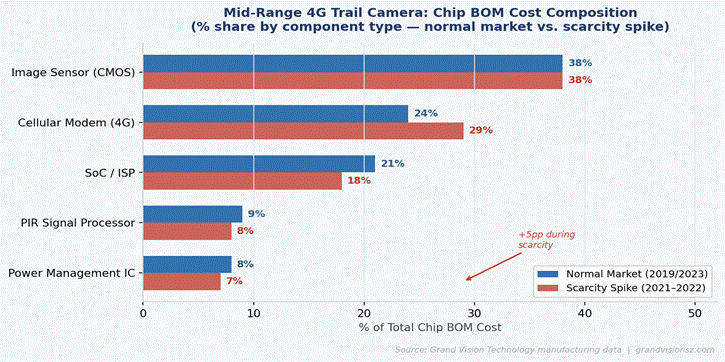
Figure 1: Chip BOM cost composition for a mid-range 4G trail camera. Image sensors and cellular modems together represent over 60% of chip bill-of-materials cost — and are the two components most exposed to supply chain volatility. During the 2021–2022 scarcity spike, cellular modem costs alone increased by 5 percentage points as a share of chip BOM.
The Volatility Pattern: What's Been Happening
The period from 2020 to 2025 has illustrated both extremes of chip pricing within a single product generation cycle.
2020–2022: The scarcity spike. COVID-19 disrupted fab capacity globally just as demand for connected consumer devices surged. CMOS image sensors — the component most directly affecting camera image quality — saw spot market prices increase 30–60% for mid-resolution units. Cellular modem supply dried up for weeks at a time as automotive and industrial customers with larger order volumes outbid consumer electronics OEMs. Several trail camera manufacturers delayed new model introductions by six to twelve months while waiting for key components.
2022–2023: The demand collapse. As consumer electronics demand normalized and fab capacity came back online, the opposite problem emerged. Component prices fell sharply — in some categories below pre-pandemic levels — but manufacturers who had built large inventory positions at peak prices were sitting on high-cost stock in a falling-price market. Margin pressure from this direction proved equally severe.
2024–2025: Structural uncertainty. Geopolitical factors — including export control developments affecting Chinese semiconductor supply — added a new dimension of unpredictability beyond simple supply-and-demand cycles. Sourcing strategies that worked well in 2019 no longer apply cleanly in 2025.
The net effect is that chip procurement is no longer a routine purchasing function for trail camera manufacturers. It has become a strategic activity.
How the Industry Is Responding
1. Qualifying Multiple Chip Sources Per Component
The most fundamental supply chain adaptation has been the expansion of approved vendor lists. Manufacturers who previously qualified a single image sensor supplier have invested the engineering time to validate two or three alternatives for each key component. This is not a trivial exercise — different sensors require different ISP tuning, and swapping an image sensor mid-production can affect night vision range, color accuracy, and trigger delay if the firmware is not re-optimized.
The payoff, however, is significant. When one supplier experiences allocation constraints, production continues with the alternative. When spot prices diverge, procurement can shift to the lower-cost qualified alternative without a re-qualification cycle.
Grand Vision's engineering approach involves maintaining qualified alternates for image sensors and cellular modems — the two highest-volatility components in our trail camera products. When a pricing anomaly makes one source materially more expensive, we can shift sourcing within the same production lot without changing the product specification.
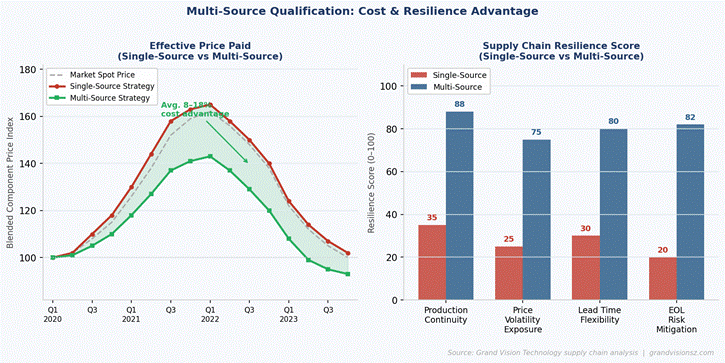
Figure 3: Multi-source qualification delivers a measurable advantage on two dimensions. Left: manufacturers with multiple qualified sources paid an estimated 8–18% less for key components during the 2021–2022 peak versus single-source competitors forced to absorb spot prices. Right: resilience scores across four supply chain risk dimensions consistently favor multi-source strategies by a factor of 2–3×.
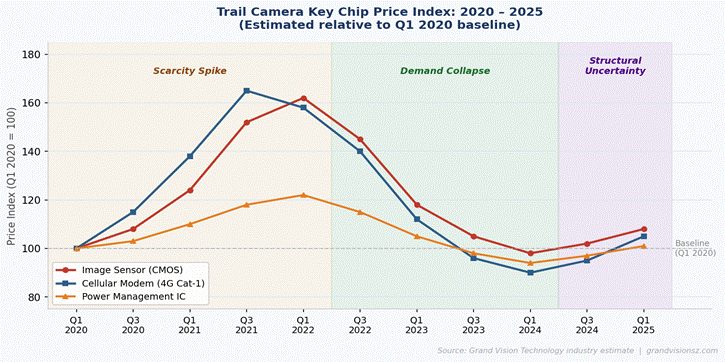
Figure 2: Estimated price index for key trail camera chip categories, Q1 2020–Q1 2025 (Q1 2020 = 100). Image sensors and cellular modems experienced the sharpest swings, with peak prices 50–65% above pre-pandemic baselines before falling sharply in 2022–2023. The post-2024 structural uncertainty phase reflects new geopolitical variables layered on top of normal supply-demand cycles.
2. Platform Design Architecture
Increasingly, trail camera manufacturers are adopting platform-based SoC strategies rather than designing around a single chip. A platform architecture means the core firmware, ISP pipeline, and application software are structured to run on a family of compatible SoCs from the same or related vendors.
This approach serves multiple purposes. Development costs for new models drop because engineers are working within a familiar software environment. When a new SoC variant is released at a lower price point with similar performance, migration is faster. And when a specific SoC hits an availability wall, the engineering team has faster options.
3. Extended Blanket Orders and Supplier Relationships
In volatile commodity markets, spot pricing is almost always more expensive than forward-contracted pricing. Manufacturers with the financial discipline and forecasting capability to place extended blanket orders — committing to purchase volumes six to twelve months forward — typically secure pricing 8–18% below spot in normal market conditions, and significantly more in peak-scarcity environments.
This requires accurate demand forecasting, which is genuinely difficult in a market where trail camera popularity is influenced by hunting season regulatory changes, weather patterns affecting wildlife activity, and retailer promotional calendars. Manufacturers who have developed better sales forecasting — through closer retailer relationships and direct market data — have a meaningful advantage in executing effective blanket order strategies.
4. Design-for-Cost Engineering
Some chip cost pressure is absorbed not through procurement strategy but through engineering. When cellular modem prices increase, engineers examine whether the product specification can be maintained with a lower-power, lower-cost modem variant. When high-resolution sensors spike in price, the engineering team evaluates whether a resolution step-down (e.g., from 36MP to 24MP) is acceptable to the target buyer segment.
This requires honest communication with the market. Buyers who have specific technical requirements need accurate specification sheets. But ffor entry-level to mid-range products where the practical difference between 24MP and 36MP JPEG images is negligible, design-for-cost engineering allows manufacturers to maintain accessible price points during component cost spikes without compromising the actual user experience.
What This Means for Distributors and OEM Buyers
Understanding the dynamics above has practical implications for buyers evaluating trail camera suppliers:
Ask about component flexibility. A manufacturer who can tell you they have multiple qualified sources for key components is a more reliable long-term supply partner than one who has not invested in alternative qualification. Component mono-sourcing creates production fragility that eventually becomes a delivery problem.
Understand the pricing basis. During periods of falling chip prices, trail camera prices should eventually trend downward. If a supplier's pricing is not reflecting component cost reduction over a one-to-two-year period, it may indicate margin recovery from a previous spike — which is legitimate — but worth understanding.
Evaluate design longevity. Platform-architecture products, where the firmware and core feature set can be maintained across chip generations, offer better long-term support reliability than single-SoC designs where a chip EOL creates an unsupportable product.
Blanket orders reduce volatility for both sides. If your volume forecasting allows it, committing to forward purchase volumes provides the supplier with the visibility to secure better component pricing — savings that can be shared in better-than-spot FOB pricing.
The Outlook
Chip pricing is unlikely to return to the stable, predictable patterns of the pre-2020 era. Geopolitical supply chain pressures, the ongoing diversification of semiconductor manufacturing geography, and the increasing silicon content of consumer electronics products all point toward continued volatility.
The trail camera manufacturers who will navigate this environment most successfully are those treating chip sourcing as a core engineering and business competency rather than a procurement afterthought. Multi-source qualification, platform architecture, forward contracting, and design-for-cost discipline are not temporary crisis responses — they are permanent capabilities that define competitive resilience in the category.
For buyers, the implication is straightforward: choose suppliers who can articulate their supply chain strategy clearly. The ability to explain how they manage component cost risk is a reasonable proxy for the operational maturity that makes them a dependable partner across multiple product cycles.
Shenzhen Grand Vision Technology Co., Ltd specializes in the design, manufacture, and direct export of trail cameras, night vision devices, and children's cameras. Our product line includes 4G, WiFi, and solar trail cameras with multiple component qualifications and a field return rate below 1%. For volume pricing, OEM inquiry, or supply chain discussion, contact sales@grandvisionsz.com.
